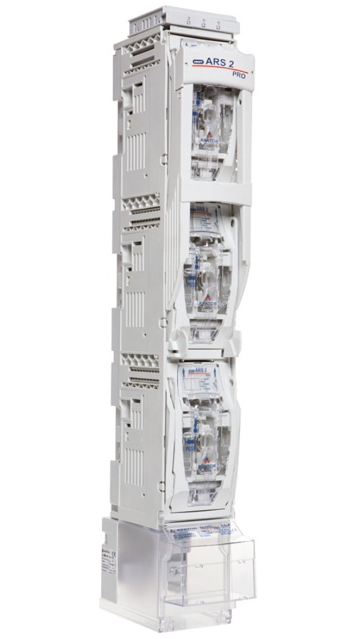
smartARS-XT pro
Fuse switch disconnector with fuse monitoring module
-
SMR fuse link blowout module
-
A flame-proof, self-extinguishing plastic with a V0 flammability class
-
Two-pole contact arrangement
Find out what the smartARS-XT pro fuse switch disconnector, SMR version, has to offer
The smartARS-XT pro fuse switch disconnector can be fitted with a device that indicates the current status of the fuse links. Information regarding blown fuses, correct operation or loss of voltage is indicated by appropriate LED signals or can be transmitted to a master system directly from the module via an RS-485 interface using the MODBUS communication protocol.
A device equipped with a CT/VT analyser interface module
SMR module output via an RS485 connector using the MODBUS communication protocol
Option to change the direction from top to bottom
Designed for installation on 185mm busbar systems
Versions
smartARS 2-XT pro fuse switch disconnectors – 400 A Installation on a 185 mm busbar system, SINGLE-POLE SWITCHING - each phase independently | Installation on a 185 mm busbar system, 3-POLE SWITCHING - all phases simultaneously |
|
|
smartARS 3-XT pro fuse switch disconnectors - 630 A | Installation on a 185 mm busbar system,, 3-POLE SWITCHING - all phases simultaneously |
|
|
Insert control module
| Description of the insert status control module’s operation | Rated parameters
|
|
|
Applications of the smartARS-XT pro fuse switch disconnector

The fuse switch disconnectors in transformer substations ensures the highest standards of operational safety. The design of the switchgear allows for rapid disconnection of the power supply. Furthermore, its resistance to harsh conditions and temperature fluctuations means the equipment does not require frequent servicing, thereby reducing operating costs.

The fuse switch disconnector is a solution designed to optimise space in LV switchgear. Thanks to its compact design, it facilitates the arrangement of equipment whilst ensuring reliable circuit protection. A well-designed connection system allows cables to be neatly and safely routed, which speeds up installation and makes future inspections easier.

The fuse switch disconnector ensures effective circuit isolation, thereby enhancing staff safety during operational work. Furthermore, the device minimises the risk of phase-to-phase short circuits, and its design guarantees the stability of the network parameters.