Energy storage for stabilising the low-voltage electricity grid
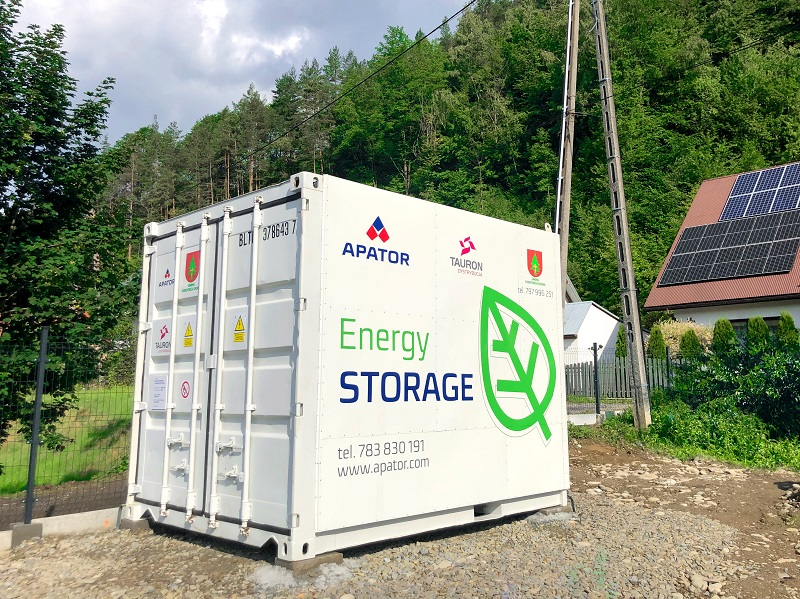
An industrial energy storage facility, a joint project between Tauron Dystrybucja, Apator and the AGH University of Science and Technology in Kraków, has been installed in Ochotnica Dolna (Małopolskie Province). The local council, which is also a partner in the project, has for years been working to improve energy security by increasing the share of RES.
Energy storage facilities
Ochotnica Dolna
Over the past few years, photovoltaic installations have been gradually being set up across the Ochotnica Dolna municipality, with PV panels being installed on the roofs of detached houses. Currently, almost 35% of buildings across the entire municipality have photovoltaic panels, and the energy they generate is used to meet the energy needs of residents. Ochotnica Dolna has one of the highest densities of prosumer photovoltaic installations in Poland. Due to the fact that most of these are single-phase installations, connected asymmetrically in individual phases, and due to the nature of the installation (lack of large energy consumers) and long sections of the low-voltage supply network, RES installations create a number of problems for the operator relating to voltage quality, particularly during periods when RES is being generated.
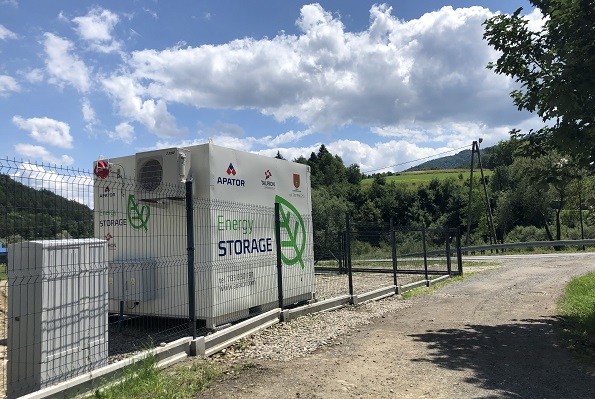
The main issues relating to power quality are phase voltage imbalance and voltage levels exceeding permissible limits during energy generation. Voltage surges cause prosumer systems to shut down, which in turn reduces the return on investment. To improve the situation, it is necessary to balance phase voltages and reduce the grid voltage level when it exceeds the permissible value.
The solution designed to help stabilise the electricity grid is to install an energy storage facility in the municipality. Its purpose will be to improve voltage parameters. In addition to Apator and Tauron Dystrybucja, the project was supported by researchers from the AGH University of Science and Technology.
Thanks to the converter application in the energy storage facility and the control algorithm developed, during periods of RES generation, the storage battery will be charged, but only from those phases where the voltage exceeds the limit. Subsequently, during the evening peak demand period and also at night, the energy storage facility will discharge into the grid so as to be ready to store energy from RES the following day.
As part of the project, it is planned to verify the operation of the energy storage system in the following modes:
Symmetrisation of phase voltages at the point of connection to the electricity grid (PPE) by transferring active power between individual phases, with a limit on phase power asymmetry dependent on the capacity of the AC/DC converter’s DC circuit
Stabilisation of voltages at the PPE by regulating the active power of battery charging/discharging independently for each phase of the supply voltage
Voltage stabilisation by regulating reactive power with a limitation on asymmetry following the maximum permissible charging/discharging of the battery
Where phase voltages are within standard limits – maintaining the battery charge level within ranges that ensure voltage stabilisation via active power, potentially depending on the time of day (hour)
Compensation of higher current harmonics, taking into account an additional current measurement circuit
Energy storage systems represent a new area of activity within the Apator Group linked to the energy transition. These solutions form an important part of the offering related to environmental protection, sustainability and a modern approach to energy.