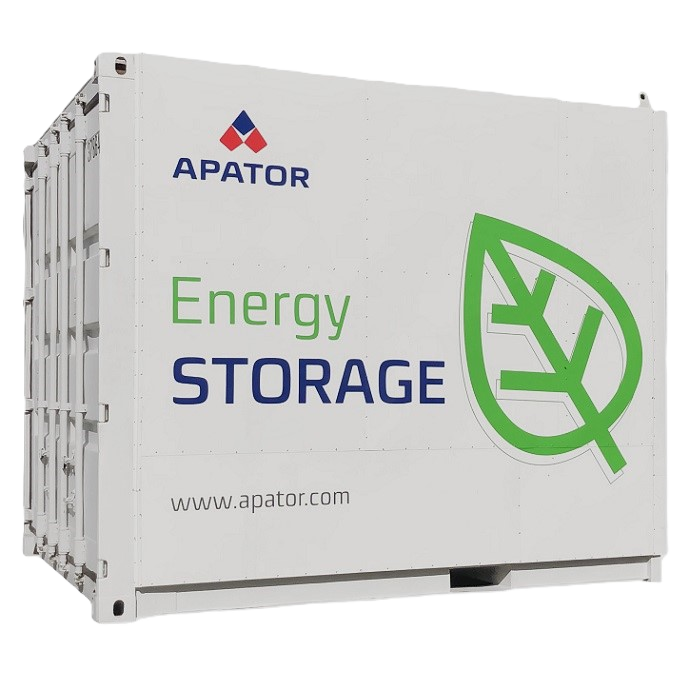
Energy storage for low-voltage distribution networks
Voltage regulation and power quality improvement in low-voltage networks
-
Improves the quality of the power supply in the low voltage network
-
Limits the disconnection of prosumer installations
-
It improves the operational stability of grids with a high proportion of RES
Find out what energy storage has to offer for low-voltage distribution networks
The energy storage system is designed for installation in low-voltage distribution networks, particularly in networks with a large number of distributed Renewable Energy Sources. The purpose of the system is to achieve voltage regulation and power quality improvement in low-voltage networks, thereby reducing outages in prosumer installations and enabling more efficient use of renewable energy sources.
The energy storage system is a complete unit, equipped with an energy storage module comprising an electrochemical battery manufactured using LFP technology, an innovative energy management system (EMS) together with grid protection (overcurrent, overvoltage, undervoltage and frequency protection), a remote communication system and a fire protection system. The design of the storage system and the application of a two-stage, bidirectional AC/DC/DC power electronic converter in a four-branch topology ensure galvanic isolation between grid and battery, as well as independent control of active and reactive power for each phase of the supply voltage.
Storage facility operating modes
The energy storage facility, managed by a master EMS (Energy Management System) controller, implements one of the following operating scenarios depending on current conditions:
- Symmetrisation of phase voltages at the point of connection to the power grid (PPE) by transferring active power between the individual phases of the supply voltage.
- Voltage stabilisation at the PPE by regulating the active power of battery charging/discharging independently for each phase of the supply voltage.
- Voltage stabilisation by regulating reactive power with asymmetry limitation when the battery reaches the permissible charge or discharge limit.
- Maintaining the storage unit’s charge level – where grid phase voltages are within standard limits, the storage unit’s charge level is maintained within ranges ensuring the possibility of voltage stabilisation via active power, potentially dependent on the time of day (hour). Where the phase voltages of the grid are within standard limits – maintaining the battery charge level within limits ensuring the possibility of voltage stabilisation using active power, potentially dependent on the time of day (hour).
- Compensation of higher current harmonics and reactive power, taking into account an additional current measurement circuit.
Improving voltage quality and stabilising the operation of low voltage networks with a high proportion of RES
Reducing disconnections of prosumer installations and increasing the use of renewable energy
Phase voltage balancing and independent control of active and reactive power
Reduction of asymmetry, higher harmonics and undesirable phenomena in the low-voltage network
Support for network operators in maintaining operational parameters without the need to expand infrastructure
The application of energy storage for low-voltage distribution networks

The energy storage system stabilises low-voltage grid parameters and improves voltage quality, which helps to minimise outages in prosumer installations and increase the use of energy from RES. By controlling active and reactive power (independently for each phase), it helps to balance and stabilise voltages at the connection point.

The storage facility improves the operating conditions of the local grid, which reduces the risk of power supply disruptions to public services and critical infrastructure. Furthermore, it can support regulatory functions (such as reactive power compensation and asymmetry mitigation), thereby enhancing energy security in the region.

The switchgear can act as a tool for ‘fine-tuning’ network parameters, compensating for local power quality issues. Depending on the conditions, it performs functions such as phase balancing, active/reactive voltage stabilisation and higher harmonic compensation, thereby supporting the reliable operation of consumers and equipment within the network.