
Asset management in the energy sector
Full control over network infrastructure. A single, up-to-date knowledge base. Data-driven decisions – from planning to maintenance
See how your business can benefit from modern EAM/CMMS systems – SID (Distribution Information System) and ZMS (Network Asset Management)
These systems form the foundation of digital Asset Management in the commercial energy sector. They integrate technical data, spatial data and business data, creating a single, coherent source of knowledge about the operator’s network infrastructure. The implementation of SID and ZMS systems enables comprehensive Asset Management of network assets as well as operational and investment processes. These systems ensure data centralisation, process automation and decision support at every stage of the infrastructure lifecycle.
By using EAM/CMMS solutions, you can:
maintain a single, comprehensive and standardised database of the network,
manage the maintenance records for equipment, stations and lines, including a full operational history,
ensure that the information provided to technical and decision-making departments is up to date and reliable,
optimise operating and capital costs through technical and spatial analyses,
reduce response times to faults and the process of connecting new customers,
integrate EAM/CMMS with SCADA, ADMS, ERP (SAP), billing and CBP systems.
Where are SID and ZMS systems most effective?
These solutions are designed for the largest Distribution System Operators (DSOs/DSOs-N), the Transmission System Operator (TSO) and companies managing extensive power infrastructure.

Full support for asset mapping, operational planning and execution, outage management, and integration with SCADA/ADMS, ERP and the Central Metering Database.

A consistent data environment for conducting analyses of network operating scenarios, simulating investments and assessing the impact of upgrades on system reliability.

Centralisation of asset data, integration with the monitoring of RES sources and energy storage facilities, support for local balancing and predictive planning.

Mobile access to documentation, passports and work orders (online/offline), with a complete audit trail and reporting for fieldwork.
Find out more about comprehensive Asset Management systems for the commercial power sector
SID and ZMS have been designed to manage extensive network infrastructure. These systems enable the centralisation of data on devices, lines, stations and associated facilities, ensuring the full digitisation of technical documentation and event history.
The solutions integrate with GIS maps (ESRI ArcGIS), SCADA/ADMS systems, ERP (SAP), billing and metering systems. As a result, data is automatically synchronised, and operational and investment processes are carried out within a single, coherent environment.
Advanced engineering analyses – flow, short-circuit and optimisation analyses – support outage planning, network development and the reduction of technical losses, forming the foundation for the implementation of the smart grid concept.
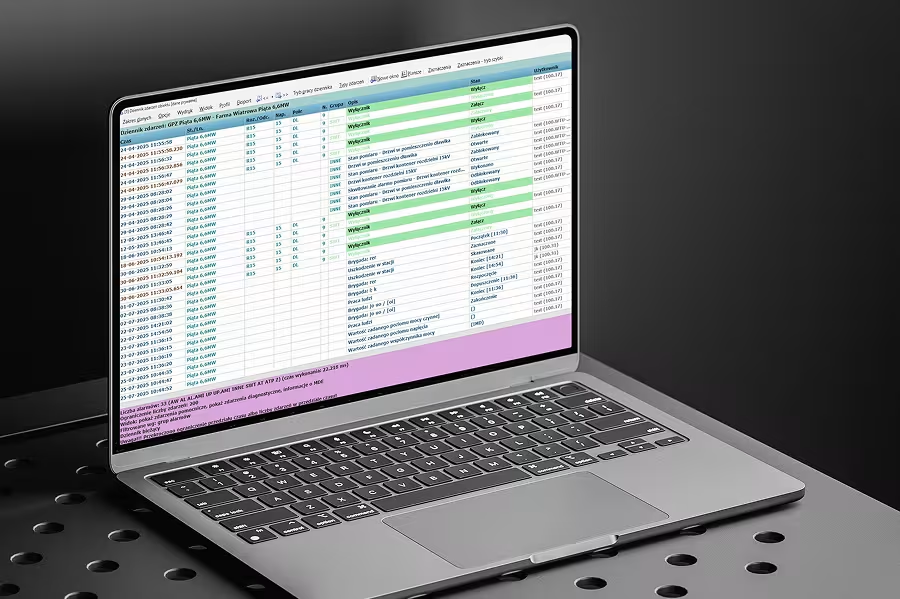
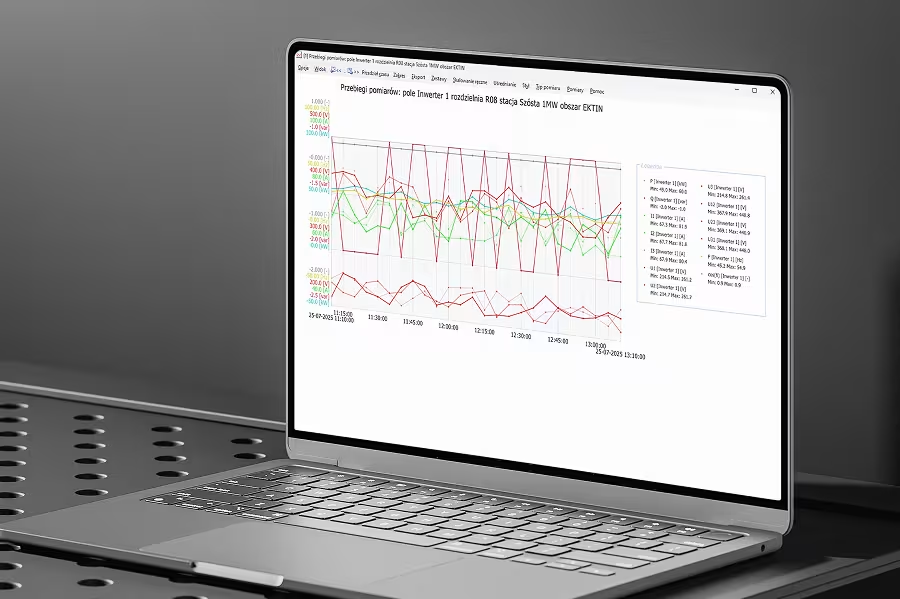
- Centralisation of information – creating a single, coherent database of network infrastructure, equipment and facilities, complete with a full operational history.
- Support for operational and strategic processes – from operational planning, through field work, to investment analyses and reporting.
- Data timeliness – the systems provide access to the most up-to-date information on the network, which is crucial for the reliability and security of energy supply.
- Integration with external systems – SCADA, ADMS, ERP (SAP), billing and metering systems, enabling the automation of data flow and processes.
Find out more about the modules that can make up a system for network asset management

Recording of network data (location, parameters, topological connections) and asset records; visualisation of relationships and internal diagrams (e.g. MV/LV substations). Search for network overlaps and collisions, import/export of geometry (SHP, CAD) and attributes (xlsx, csv), generation of single-line diagrams for engineering calculations. Support for investment design, cost estimates and seamless cooperation with development modules.

A generator of requirements and tasks for mandatory maintenance procedures (based on rules, deadlines and facility records), with automatic generation of maintenance schedules for departments. Performance reports (monthly/annual), comparison of planned vs. actual costs (RBH, PLN), integration with SAP (group costs) and the map (visualisation of scopes, exclusions, faults).

Management of scheduled, ad hoc and emergency work; allocation of tasks to work orders (from a map); issuing of work orders (health and safety, breaks, responsible persons). Generation of inspection sheets and measurement reports; automatic defect register based on assessments from the sheets; full integration with mobile apps, tracking of work crews (GPS). Integration with SAP (settlement orders, orders with contractors, costs allocated to orders).

Outage planning with visualisation of the affected area on a map; linking work orders to a single actual outage. Recording of actual outages (data from SCADA), load measurement, validation algorithms (scheduling conflicts, single-use/cumulative limits, high-priority PPE). Reporting of undelivered/saved energy and SAIDI/SAIFI indicators.

Events panel (HV/MV/LV, faults, switching operations, tripping); rapid creation of events linked to network assets; coordination of teams and work orders. Log of deactivated assets throughout the event lifecycle; tight integration with SCADA and the map.

Record-keeping for meters, transformers, modems/EZO devices, and numbered seals (with bulk number generation); warehouse and document management (PZ, MM, LN, WZ, SW), calibration laboratory/workshop. Installation card (OT/OTS) – installation/removal, parameterisation, reading; integration with billing and remote reading systems; bulk meter verification orders.

• Connections for energy consumers.
• Connections for energy producers.
• Increasing the required connection capacity.
• Splitting and merging installations within a facility.
• Temporary connection to the grid.
• Management of energy consumption points.

• Request management (emergency calls, complaints, TOO).
• PP management (generation in accordance with GS1, changes, closures, support for prosumers and producers), full customer and PP profiles.
• PP visualisation on a map.
• Cooperation with the ZET Mobile app (processing of requests in the field).
• Cooperation with billing systems and the Central Metering Database (CBP).
• Cooperation with the CSIRE system regarding the creation and updating of PP characteristics, PP enquiries, and electricity supply management.

Assigning orders to teams (online, notifications), mobile inventory (meters, seals, transformers), order fulfilment on-site (readings, parameterisation, installation/removal, debt collection), attachments/photos. Order returns/cancellations, status synchronisation, automatic updating of results in ZMS and external systems.

Records of plots, buildings, road rights-of-way, premises and fixed asset groups; management of claims and easements, full history of changes. Fees/taxes, document repository, periodic reports (paid/unpaid, fixed-term contracts, easements, capital expenditure), letter template generators, data export (xlsx), alerts for expiring contracts. Deep integration with the map (mark-ups, multipolygons, automatic object matching), cooperation with the Plan/Execution modules and generation of PT/LT/OT asset document orders for SAP.
Power flow calculations, loads and capacity, power/energy losses, short circuits (including low-voltage), short-circuit loop impedance, SWZ conditions, earth resistances, capacitive currents. Simulation of switch states (actual from external systems and scenario-based), saving of models and reports, visualisation of results against map backgrounds (LV/MV/HV). Reduction of technical losses, improved selection of protective devices, support for outage planning – a component of the smart grid environment.

Planning: gathering requirements from across the company (connections, conflicts, development/modernisation, non-network-related), integration with GIS, fixed asset data from SAP, 10-year horizon (investment plan), 24-month forecasts (RBH, budgets), “One-click Development Plan” and rapid URE reports. Implementation: automatic propagation of changes from the plan, PS/IM, FI-AA, MM in SAP, material reserves, 10-year budgets, acceptance procedures (committee, documentation), OT/LT and updating of inventory numbers on the map.

Industry-specific and site-specific arrangements and documentation; conflict resolution options created in text form or plotted on a map (Design layer) with cost calculations based on standard rate catalogues; integration with Plan/Execution/SAP (PSP, budget, invoices).

Management of accounts (including integration with Active Directory), permissions, organisational structure, dictionaries/directories, infrastructure object profiles (requirements, description, order, visibility), and a full change history.
Manage your network assets comprehensively
Find out how SID and ZMS can streamline the operation, investment and maintenance of energy infrastructure
Services you might be interested in


Explore other solutions for the commercial energy sector

Effectively manage your network assets using reliable and up-to-date data

Improve network reliability and respond effectively to incidents with comprehensive infrastructure monitoring
Frequently Asked Questions
A single database, faster decision-making, reduced connection and fault-resolution times, improved investment planning and lower operating costs thanks to automation and analytics.
Yes, asset mapping and digitisation form the foundation of the smart grid; engineering calculation tools, integration with CBP/SCADA and development modules support predictive grid control and the integration of RES.
ZMS/SID systems are designed for deep integration (PS/IM,FI-AA, MM in SAP; SCADA/ADMS; billing/CBP); this is confirmed by implementations at distribution system operators.
Yes, the ZET and Teren Zlecenia mobile apps work both offline and online; once connectivity is restored, the data is synchronised and the location of the teams is visible on the map (GPS).
Application registration, technical requirements, contracts/addenda, project initiation, PPE generation and management, connection status reports. All in one place, with integration with related modules.
The Outage Module schedules and records outages (SCADA), checks for conflicts and limits, calculates energy not supplied/saved, and reports SAIDI/SAIFI figures.
Yes, a comprehensive inventory of devices, stock records/documents, installation sheets, bulk verification orders, and integration with billing/meter reading systems.
Development – Planning (10-year plan, forecasts, Energy Regulatory Office) and Development – Implementation (Power System Plan, budgets, reserves, acceptance tests, high-voltage/low-voltage networks, map updates) — fully integrated with SAP and GIS.
The Property Module maintains records of properties, easements and claims; it integrates with the map; and generates reports and requests for PT/LT/OT property documents to be sent to SAP.
Manage your network infrastructure using data
See SID and ZMS in action. Ask for a demo featuring a map of your network and engineering analyses