Improve the efficiency of your heating and cooling systems with heat meters that comply with MID requirements. Choose durable, interference-resistant solutions designed for use in remote reading systems. Take advantage of modern transducers and converters that guarantee measurement accuracy, stable readings and full integration with the building’s technical infrastructure.
Choose equipment that makes it easier to monitor heat and cooling consumption
Elf 2 (DN15–20)
Compact heat meters
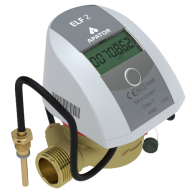
A high-quality compact heat and cooling meter with a Class 2 turbine flow transducer
Can operate as a heat meter, a cooling meter or a combined heat and cooling meter within the same system
Based on single-jet flow transducers for horizontal (Class 2) or vertical (Class 3) installation
FAUN
Split heat meters/energy calculators

A top-of-the-range heat meter converter for professional applications, offering the widest range of measurement, data archiving and communication capabilities
It is compatible with ultrasonic and mechanical flow transducers, as well as paired temperature sensors, which are separate measuring devices forming part of split heat meters (including those from other manufacturers on the market)
A version is available with a fixed pulse rate and the installation points (power supply/return) shown on the LCD display
Monitor, collect and analyse measurement data using advanced software

Frequently Asked Questions
A heat meter (heat meter/cooling meter) is a measuring device designed to measure energy consumption in heating or cooling systems used in residential, office or industrial buildings. The gigajoule [GJ] is the energy unit commonly used for billing purposes.
A heat/cooling meter, as a complex measuring system, comprises the following modules:
- flow transducers – mechanical (vane, screw, volumetric) or ultrasonic meter for measuring the volume of the flowing heating medium,
- sensors for measuring the power supply and return temperatures of the heating medium,
- converter – a digital system that converts the measured values into the amount of heat/cooling flowing through the system.
Heat meters measure the amount of energy released by hot water as it cools down whilst heating rooms, for example. They measure the volume of water that has flowed through, releasing heat, as well as two water temperatures: before and after cooling. This energy is proportional to the volume of water and the temperature difference between the power supply and return lines.
The heat meters must be installed in accordance with the manufacturer’s instructions. The location chosen for the heat meters should be easily accessible for installation, removal and maintenance, convenient for reading, and separate from utility rooms. The heat meters must be positioned in such a way that they are protected from impacts, vibrations and electromagnetic fields, as these may interfere with the device’s operation. It is advisable to install shut-off valves upstream and downstream of the heat meter. The accuracy of the heat meter’s readings may be affected by flow disturbances occurring upstream or downstream of the flow transducers, caused in particular by the presence of flow-disrupting fittings, e.g. elbows, valves or pumps – the installation should be fitted with straight sections of pipework upstream or downstream of the flow sensor, with lengths determined by the sensor and the manufacturer’s recommendations, so that the heat meter’s measurement errors remain within the permissible error limits.
Readings can be taken manually by checking the display of the heat meter, or using remote reading modules.
Energy units available to the customer: GJ, kWh or Gcal.
In accordance with the temperatures specified in the technical data in the product catalogue. A distinction is made between the ambient temperature at which the heat meter operates, which is 5–55°C, and the heating water temperature, which varies depending on the flow transducers used in the heat meters. For example, for the Elf 2 compact heat meter, it should be within the range of 0.1 –90°C, whilst for ultrasonic transducers in split heat meters with a Faunem calculator, it should be within the range of 5–130°C (for DN15–DN20) or 5–150°C (for DN25–DN100)
Compact heat meters are compact devices comprising: a flow meter, a conversion unit and a pair of temperature sensors, one of which is installed in the body of the flow meter, whilst the other is mounted on the relevant return/power supply pipe in a t-joint. They have a single approval for measurement covering the entire device.
Hybrid heat meters differ from compact ones in that the calculation unit can be removed from the flow transducer and mounted, for example, on a wall, but remains connected to the transducer at all times via a non-detachable cable.
Split heat meters consist of three independent devices: a calculator, a flow transducer and temperature sensors connected to the calculator via detachable cables. A characteristic feature of split heat meters is the ability for components from different manufacturers to be applied whilst ensuring full compatibility.
Each of the component devices has its own approval.
The validity of the conformity assessment procedure (initial legalisation) is calculated from 1 December of the year in which the mark was affixed to the instrument during the conformity assessment. The validity of the initial verification following the conformity assessment is 5 years (in accordance with the Regulation of the Minister of Entrepreneurship and Technology of 22 March 2019 and pursuant to Article 9(1)–(5) of the Act of 11 May 2001 – Law on Measurements (Journal of Laws of 2019, items 541 and 675). If the conformity assessment expires, the heat meter cannot form the basis for billing.
Following secondary verification, the heat meter bears a verification mark consisting of two seals. One seal indicates the year and the other the month; this combination specifies the final date of the five-year validity period of the secondary verification assigned to the measuring device in question. If the conformity assessment expires, the heat meters cannot be used as the basis for billing.
Yes. Neither wireless nor wired remote reading poses a health risk. This is confirmed by the declarations of conformity issued for the radio communication modules by the manufacturer, in accordance with specific European Directives and harmonised standards.
Yes. The primary piece of legislation governing the allocation of costs for the purchase of heat for a building containing residential and commercial premises is the Energy Law Act (Journal of Laws of 19 April 2021, item 716 (consolidated text of the Act)). Specifically, Article 45a(8) stipulates that these costs may be settled using methods based on readings from heat meters (…). In the following section (paragraph 9), the Act states that the owner or manager of a multi-unit building shall select a method for settling the total costs of heat purchase in such a way as to “(…) encourages energy-saving behaviour and ensures that the charges referred to in paragraph 4 are determined in a manner corresponding to heat consumption for heating (…)”.


Choose precise and intelligent heat consumption measurement
Speak to an expert and find the right metrology solution for your project
Choosing a heat meter – what technical specifications should you look out for?
Choosing the right heat meter is a crucial step in the design and installation of heating and cooling systems. To ensure the device operates with high accuracy, several key technical parameters must be considered. The most important of these are:
- nominal diameter DN,
- flow range (qp, qi, qs),
- medium temperature,
- operating pressure,
- accuracy class.
Equally important is the type of flow transducer (ultrasonic, mechanical or electromagnetic), which affects measurement accuracy and resistance to contamination in the system.
When selecting a heat meter, it is also worth considering the installation length, mounting method (horizontal or vertical) and standards compliance. For installations integrated with BMS systems, the ability to communicate via M-Bus, Modbus, OMS or LoRaWAN standards will be important, as this facilitates remote data reading and integration with smart innovative energy management systems.
How does remote heat reading work?
Remote heat metering is a modern solution enabling the automatic collection of data from heat meters without the need for physical access to the device. The system relies on radio or wired communication, depending on the application. Heat meters equipped with M-Bus, Wireless M-Bus, NB-IoT or LoRaWAN modules transmit data on heat consumption to a central database or server, where it is analysed and archived.
Thanks to remote reading, you can monitor heat energy consumption in real time, quickly detect anomalies and optimise the operation of the system. This solution significantly streamlines the billing process, eliminates human error and enables remote diagnostics. For HVAC specialists and building managers, it provides the basis for implementing modern energy management strategies and improving the energy efficiency of facilities.